Exploring the Wonders of the Galaxy
A Deep Dive into the Galaxy and Beyond
Types of Galaxies
Galaxies are concentrations of stars, gas, dust, and dark matter. They come in a variety of shapes and sizes. Some are fated to collide, like the Milky Way and Andromeda.
Astronomers classify galaxies into three major categories: elliptical, spiral and irregular.
Ellipticals, which account for about one-third of galaxies observed, possess comparatively little gas and dust, contain older stars and are not actively forming stars anymore.
Spiral galaxies appear as flat, blue-white disks of stars, gas and dust with yellowish bulges in their centers.
Irregular galaxies, which have very little dust, are neither disk-like nor elliptical. Astronomers often see irregular galaxies as they peer deeply into the universe, which is equivalent to looking back in time. These galaxies are abundant in the early universe, before spirals and ellipticals developed.
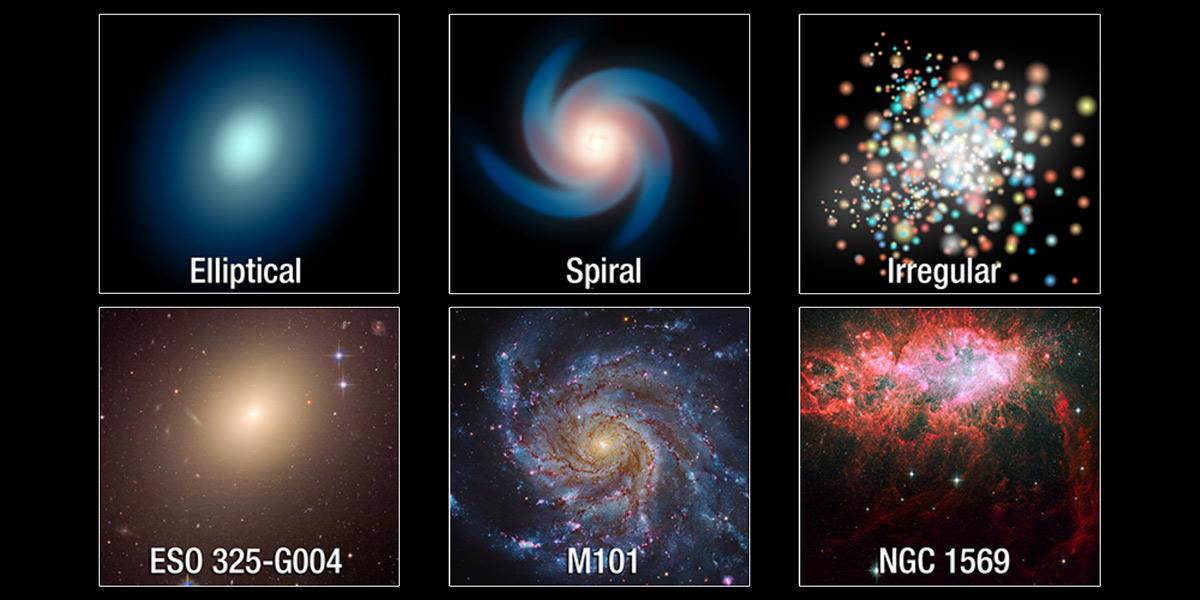
This graphic compares illustrations of the three main types of galaxies (top) with actual photos of galaxies (bottom) that fit the categories.
Credit: A. Feild (STScI)
Explore our Blog..
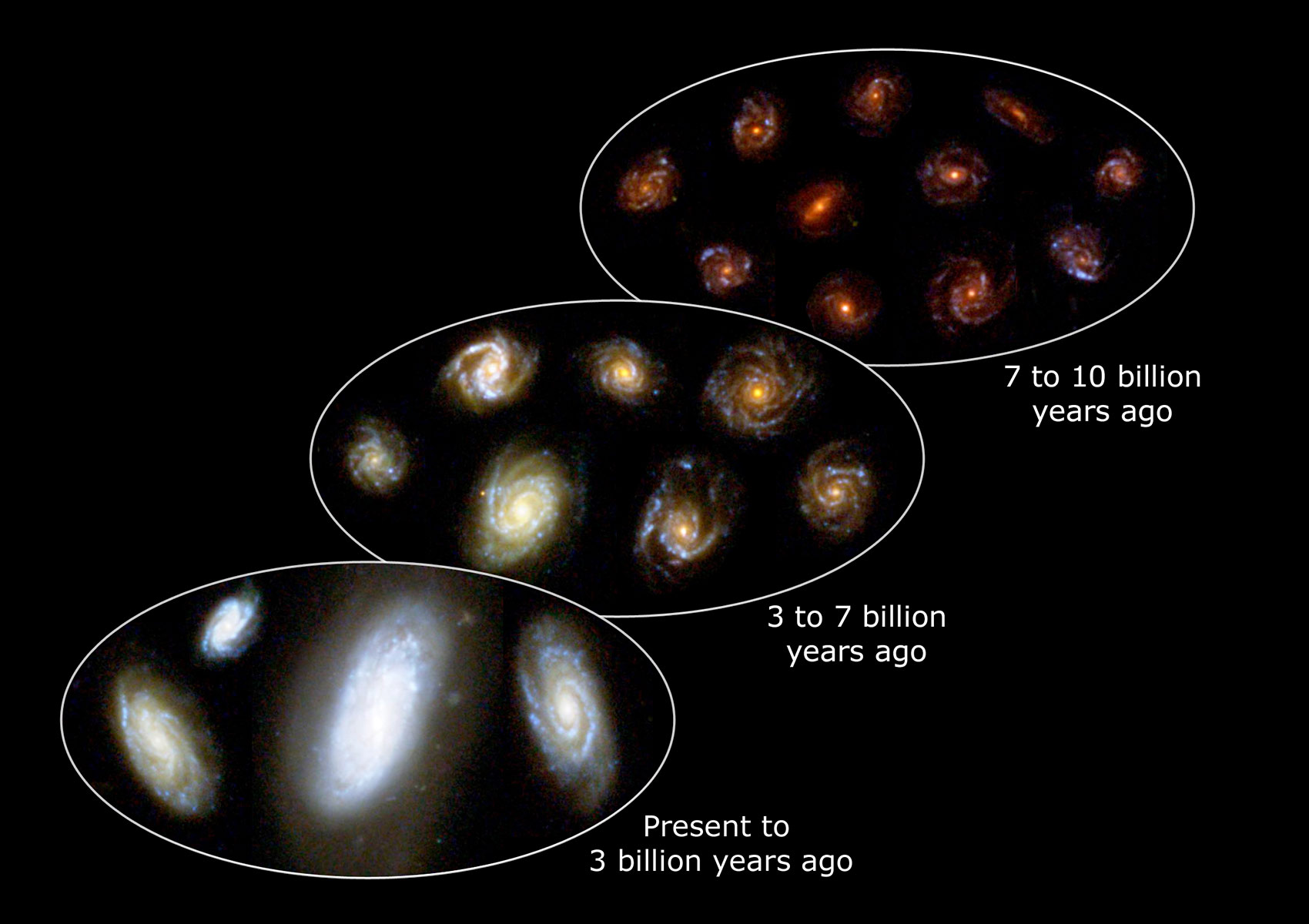
A selection of spiral galaxies from the Great Observatories Origins Deep Survey (GOODS) are grouped by their distance, and therefore by the time at which they are seen.
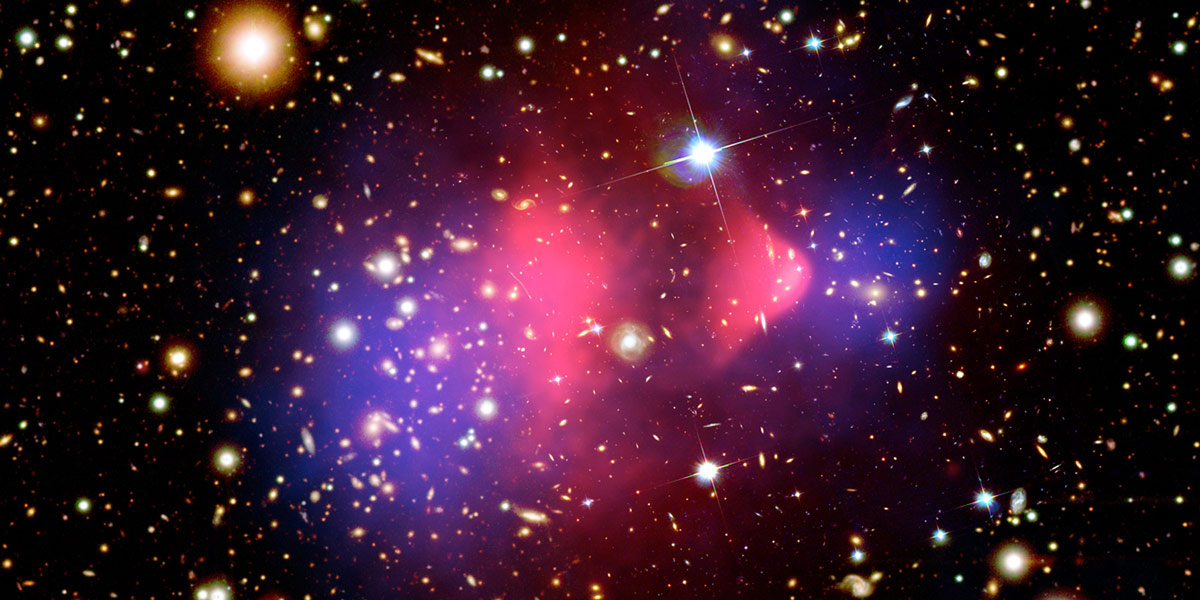
The Bullet Cluster was formed after the collision of two large clusters of galaxies. Hot gas detected by Chandra in X-rays is seen as two pink clumps in the image .
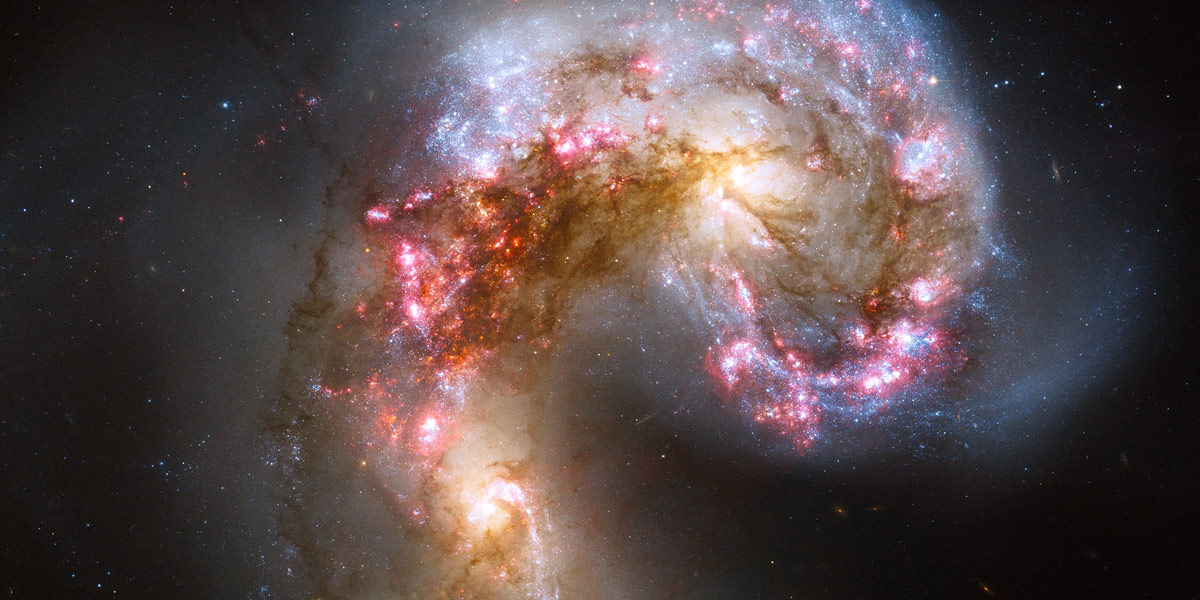
This celestial firestorm is the blazing wreckage of a collision between two spiral galaxies that began a few hundred million years ago.
PLANETS
Mercury
Venus
Earth
Mars
Jupiter
Saturn
Uranus
Neptune
SOLAR SYSTEM
Sun
Eclipses
Kuiper Belt
Oort Cloud
Comets
Meteors & Meteorites
Asteroids
MORE
News
Resources
Missions
Interactives
Raw Images
People
STAY CONNECTED

Copyright © 2023 Astral Atlas Inc. All rights reserved. About Us | Bibliography | Feedback | Privacy | NASA | Directorate | Site Map India
Site maintained by Shashank Malhotra at Netsmartz Academy for Netsmartz’s Science Mission Directorate.